Breaking Down the Rules of Cricket for New Fans: A Beginner's Guide
What Is Cricket and Why Should New Fans Care?
Cricket is a bat-and-ball sport played between two teams of 11 players, and it's one of the most-watched sports on the planet — with a global following of roughly 2.5 billion fans, concentrated across South Asia, the UK, Australia, and the Caribbean. If you've ever flicked past a match and felt instantly confused, you're not alone. Cricket has its own language, its own logic, and its own rhythms. But once those click into place, it becomes genuinely compelling.
What makes cricket worth your time? The game operates on multiple layers simultaneously. There's the physical contest between bowler and batsman, the strategic puzzle of field placement, and the psychological pressure of a five-day Test match where momentum can shift over hours. Even the shorter formats — 20-over T20 games — pack enough drama into three hours to rival any sport for entertainment value.
This guide walks you through everything you need to follow your first match without feeling lost.
The Basic Setup — Teams, Positions, and the Playing Field
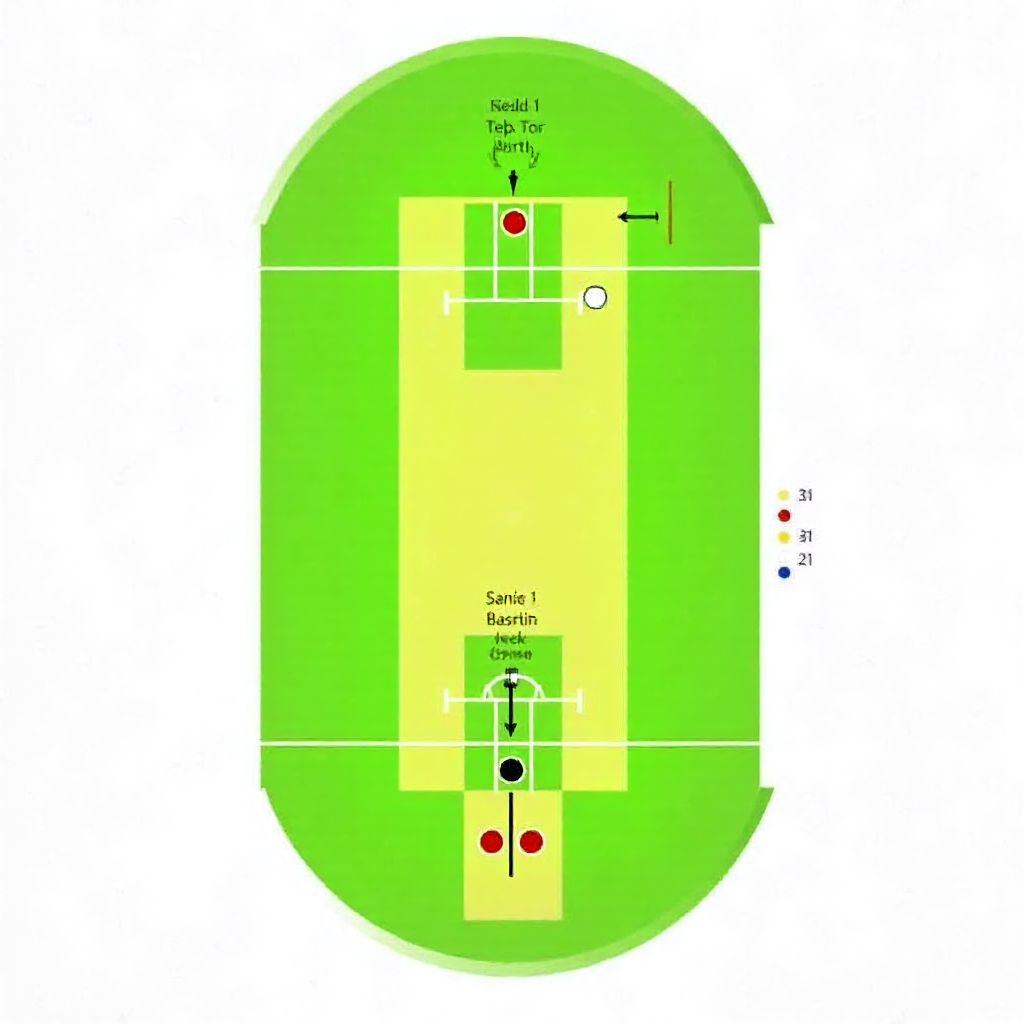
Cricket is played on a large oval field with a rectangular strip of ground at its center called the pitch. At each end of the pitch sit three upright wooden poles called stumps, topped by two small crosspieces called bails — together, this structure is the wicket. Protecting the wicket is the batsman's primary job.
Each team fields 11 players. One team bats while the other fields. The fielding team has a bowler delivering the ball from one end, a wicketkeeper crouching behind the stumps at the other end, and nine other fielders spread across the oval in various positions.
Those fielding positions have names that sound cryptic at first — slip, gully, mid-on, mid-off, square leg, fine leg — but they simply describe where on the field a player stands. The fielding captain arranges these players based on tactics: trying to cut off likely scoring areas or setting traps for specific batters.
The crease is a line painted on the pitch near each wicket. It marks safe ground for the batsman — as long as some part of their bat or body is behind the crease, they can't be run out. Think of it as a home base.
How Scoring Works — Runs, Boundaries, and Extras
The basic unit of scoring in cricket is the run. A batter scores runs by hitting the ball and physically running to the opposite end of the pitch — both batters must cross and reach the other crease to complete one run. They can run multiple times on a single delivery if the ball travels far enough.
Hit the ball to the boundary rope along the ground? That's an automatic four runs. Clear the boundary rope in the air without bouncing? That's a six — the most exciting shot in the game, equivalent to a home run in baseball. Sixes are the crowd-pleasers that make T20 cricket so electric.
Extras are bonus runs added to a team's score without the batsman hitting the ball. They come in a few forms:
- Wide: A delivery bowled too far from the batsman to be playable
- No-ball: An illegal delivery (often because the bowler's foot crossed the crease line)
- Byes and leg byes: Runs scored when the ball passes the bat without being hit, or deflects off the batsman's body
Extras might seem minor, but in tight matches they can be decisive. A team that bowls too many wides effectively gifts the opposition free runs.
How a Batter Gets Out — The Ways to Lose a Wicket
A batsman is dismissed — or "loses their wicket" — when one of several specific events occurs. There are ten ways to get out in cricket, but four cover the vast majority of dismissals you'll see in any match.
- Bowled: The ball hits the stumps directly, dislodging the bails. Clean, undeniable, often spectacular.
- Caught: A fielder catches the ball before it touches the ground after the batsman hits it. The most common form of dismissal in professional cricket.
- Run out: A fielder hits the stumps with the ball while the batsman is outside the crease during a run. Often involves a direct throw and a close call.
- LBW (Leg Before Wicket): This one trips up almost every new viewer. If the ball hits the batsman's leg (or body) instead of the bat, and the umpire judges that the ball would have gone on to hit the stumps, the batsman is out LBW. It's a judgment call, and it generates enormous debate — especially since the introduction of ball-tracking technology used in TV reviews.
When a wicket falls, a new batsman walks in. A team's innings ends when ten wickets have fallen (since you need two batters at the crease, the last man standing can't bat alone).
Overs, Innings, and Match Formats Explained
An over is a set of six legal deliveries bowled by a single bowler from one end of the pitch. After six balls, a different bowler takes over from the opposite end. No bowler can bowl two consecutive overs. This rotation is one of the key tactical decisions a captain makes throughout a match.
An innings is the batting turn for an entire team — it ends when ten wickets fall or the allocated overs run out. Here's where the three main formats diverge significantly:
- Test cricket: Each team gets two innings, with no over limit. Matches last up to five days. This is the oldest and most traditional format, rewarding patience and skill over five sessions of play.
- ODI (One Day International): Each team bats one innings of 50 overs. Matches last around eight hours. ODIs balance strategy with entertainment — the 2019 Cricket World Cup final between England and New Zealand is widely considered one of the greatest sporting events ever played.
- T20: Each team bats one innings of 20 overs. Matches finish in about three hours. Fast, loud, and full of big hitting — T20 is the format that's attracted millions of new fans globally through leagues like the IPL and the Hundred.
Choosing which format to watch first depends on your patience. T20 is the obvious entry point for new fans. Test cricket rewards you once you understand the deeper tactical layers.
Key Strategies That Make Cricket Interesting
Cricket's strategic depth is what separates it from a simple hitting game. The chess match between captain, bowler, and batsman plays out on every single delivery.
Field placement is one of the most visible tactics. A captain sets fielders to cut off the batsman's preferred scoring zones — if a batter loves hitting through the covers, the captain might pack that area with fielders, forcing them to play differently. Watch how the field shifts between deliveries and you'll start reading the game at a new level.
Bowling tactics add another dimension. Bowlers can swing the ball through the air, spin it off the pitch, or vary their pace to deceive the batsman. A well-set batting partnership — two batters who communicate well and rotate the strike efficiently — can frustrate even the best bowling attack by denying them easy wickets.
In limited-overs cricket, the concept of "run rate" adds a time-pressure element. Teams need to score at a certain pace to post a competitive total, which forces aggressive shot selection and creates risk. That tension between attack and caution is where cricket's drama lives.
How to Keep Learning — Watching, Playing, and Mobile Cricket Games
The best way to cement your understanding of cricket's rules is to watch live matches while keeping this guide handy. Commentators explain decisions in real time, and modern broadcasts include graphics showing ball-tracking data for LBW reviews and wagon wheels mapping where each batter hits the ball.
If you want a more hands-on way to internalize the rules, mobile cricket games are surprisingly effective. Games like Real Cricket or Cricket League simulate batting, bowling, and fielding decisions, which forces you to actually apply the rules rather than just read about them. When you're deciding whether to play a defensive shot or go for a six, the risk-reward logic of cricket starts making intuitive sense fast.
Following a specific team also helps. When you have a stake in the outcome, the rules become relevant rather than abstract. Pick a national team playing in an upcoming T20 series and watch a couple of matches — by the third game, you'll be following the action without needing to look anything up.
For a deeper dive into the official laws of the game, the MCC Laws of Cricket at Lord's is the authoritative reference — dense, but useful when a specific ruling confuses you.
Frequently Asked Questions
How long does a cricket match last?
It depends on the format. T20 matches last around 3 hours, ODIs take roughly 7–8 hours spread across a full day, and Test matches can last up to 5 days (though they often finish earlier). Most new fans start with T20 for exactly this reason.
What happens if it rains during a match?
Play is suspended and the covers come on to protect the pitch. In Test cricket, lost time can result in a draw. In limited-overs formats, the match may be shortened or, if enough overs haven't been bowled, abandoned entirely — sometimes resulting in a shared points outcome.
What is the Duckworth-Lewis-Stern (DLS) method?
The DLS method is a mathematical system used in rain-affected limited-overs matches to recalculate a revised target for the team batting second. It accounts for both overs remaining and wickets in hand to produce a fair adjusted target. It's notoriously confusing even for experienced fans — just know that it exists and that it's considered the fairest available solution to an inherently tricky problem.
How is the winner decided in a tied match?
In Test cricket, a tie (both teams dismissed for the same score) is extremely rare and simply recorded as a tie. In T20 and ODI cricket, tied matches typically go to a Super Over — each team faces one over of six balls, and whoever scores more wins. If that's also tied, further Super Overs or boundary count rules may apply depending on the competition.
What's the difference between a no-ball and a wide?
A no-ball is an illegal delivery — most commonly because the bowler's front foot crossed the crease line at delivery. A wide is a legal delivery that passes too far from the batsman to be playable. Both result in one extra run for the batting team and a free hit (in T20 and ODI cricket) after a no-ball, meaning the batsman cannot be dismissed off the next delivery except by a run out.